Naval Newsによると、ワシントンD.C.近くで開催された、Sea Air Space 2021において、ボーイングが、艦載戦闘機用の極超音速ミサイル:Hyfly2のコンセプト図を発表した。X-51A以降、ボーイングは、ロッキードマーチンとレイセオンに敗れていたが、Hyfly2で巻き返しを図る模様である。
1. Sea Air Space 2021で発表されたコンセプト図
Naval Newsによると、ワシントンD.C.近くで開催された、Sea Air Space 2021において、ボーイングが、艦載戦闘機用の極超音速ミサイル:Hyfly2のコンセプト図を発表した。
According to Naval News, at Sea Air Space 2021 held near Washington D.C., Boeing presented concept drawing of Hyfly2, a hypersonic missile for use carrier-based fighter aircraft. Boeing has been losing ground to Lockheed Martin and Raytheon since the X-51A, but with the Hyfly2, it seems to be trying to get back on track.
1. Conceptual drawing presented at Sea Air Space 2021
According to Naval News, at Sea Air Space 2021 held near Washington D.C., Boeing presented concept drawing of Hyfly2, a hypersonic missile for use carrier-based fighter aircraft.
Hyfly2 concept drawing
Boeing continues to design and invest in future hypersonic cruise missiles, and according to another article in Aviation Week, the U.S. Department of Defense has brought Boeing into the competition with its Mach 6 HyFly2 program, funding preliminary design reviews and ground testing of the DCR (Dual Combustion Ramjet).
In its R&D performance with Hyfly in the 2000s and X-51A in the early 2010s, Boeing was the leading U.S. company in the development of scramjet-powered missiles. However, since the mid-2010s, Boeing has been losing contracts and competition for U.S. military contracts to Lockheed Martin and Raytheon in the hypersonic missile field and for orders for scramjet-equipped missiles. Boeing seems to be trying to regain its footing with the Hyfly2.
2. Features of Hyfly2
The Hyfly2, like the Hyfly, is a Dual Combustion Ramjet (DCR), and a detailed description of the engines used in the Hyfly is given in a previous article below.
The Hyfly is a hybrid engine that combines a ramjet engine and a scramjet engine, a concept that was shown at APL in the 1970s. The Hyfly project was developed assuming a cruise speed of Mach 6, and the Hyfly2 project also assumes Mach 6, and is expected to be equipped with an improved version of the Hyfly. The Hyfly2 project also assumes Mach 6 and is expected to carry an improved version of Hyfly.
Comparison between Hyfly2 and Hyfly/X-51A
From the concept drawing, we can see the circular nozzle and the X-shaped steering wing inherited from Hyfly at the rear.
On the other hand, the inlet section is a single two-dimensional inlet, just like the X-51A. Also, like the X-51A, it has the characteristic of a web rider shape with a cut from the side of the inlet to increase lift under shock waves. From this, we can see that the concept is a combination of Hyfly and X-51A.
The Hyfly and X-51A have been tested for air launch in the 2000s and early 2010s, respectively; the X-51A achieved powered flight with a scramjet engine, but the Hyfly failed and the project was cancelled. This is just a guess, but it may mean that the X-51A's two-dimensional inlet system was superior to the X-51A's in order for the inlet to work properly, and the DCR was superior to the X-51A's combustion system for maintaining supersonic combustion.
In order to achieve DCR, the inlet for ramjet combustion and the inlet for scramjet combustion were separated and placed at the tip of the Hyfly. However, the concept drawing of Hyfly2 has only one inlet like the X-51A, and in order to achieve DCR combustion with this shape, it is expected that the inlet will be divided into two channels, one for ramjet and one for scramjet.
3. Aerojet Rocketdyne was acquired by Lockheed Martin
In the R&D program for the X-51A, Pratt & Whitney Rocketdyne (now Aerojet Rocketdyne) was in charge of developing the SJX61/SJY61 scramjet engine to be installed in the X-51A. (now Aerojet Rocketdyne) was responsible for the development of the SJX61/SJY61 scramjet engines to be installed in the X-51A.
SJX61/SJY61 Scramjet Engine
Aerojet and Rocketdyne, long-established manufacturers of rocket engines and missile propulsion systems from the early U.S. space program to the space shuttle, merged in 2013 to become Aerojet Rocketdyne. However, this one and only manufacturer was acquired by Lockheed Martin in December 2020. As a result, Boeing may not be able to use Aerojet Rocketdyne, a direct competitor under Lockheed Martin, as a vendor.
Aerojet Rocketdyne is also believed to be responsible for some of the engines for the large scramjet-powered aircraft that are under development, such as the SR-72. Although there are various US military programs to develop hypersonic missiles, Lockheed Martin has surpassed its competitors in the number of contracts and continues to lead the pack.
ブレヴェストニク巡行ミサイルには、原子力推進ジェットエンジン(ターボジェットエンジン or ターボファンエンジン)が搭載している物と見られる。ジェットエンジンは、外部から空気を取り入れて噴流(ジェット)を生成する推進機関と定義されるので、「ジェットエンジンの実験中に爆発」という報道は嘘ではないとロシア側は主張出来る。
In August 2019 in Russia, there is a lot of talk about the 9M730 Brevestnik nuclear-powered propulsion cruise missile, which may have caused a nuclear accident during its development. This article describes a discussion of the 9M730 Brevestnik nuclear-powered propulsion cruise missile.
1.9M730 Brevestnik Nuclear Cruise Missile
9M730 Burevestnik Burevestnik, Burevestnik (NATO CODE: SSC-X-9 Skyfall Skyfall Skyfall) (NATO code like the title of 007...) is a nuclear-powered propulsion cruise missile under development by Russia. The missile was announced by President Putin on March 1, 2018, along with a variety of new weapons, and will be powered by a nuclear-powered air-breathing engine. It is said to have a vast global range, as it will be nuclear propelled rather than chemically propelled.
2.A revival of a Cold War-era concept
During the Cold War, the nuclear-powered propulsion cruise missile was a long-range cruise missile capable of crossing the continent that was considered in the United States in the 1950s and 1960s. However, developments in technology such as intercontinental ballistic missiles (ICBMs), which could reach targets in a shorter time frame, led to the cancellation of the program at that time.
In recent years, the United States has been developing a ballistic missile defense (MD) system capable of intercepting ballistic missiles, and Russia has been exploring multiple countermeasures to counter this, one of which is the Brevestnik cruise missile, a revival of the US concept from the 1950s and 1960s.
Several new weapons developments are being carried out in Russia with the aim of going under the MD, and while the formula is different from the Avangard and other new weapons groups announced by President Putin on March 1, 2018, the objectives are the same.
【Related article on new weapons introduced by President Putin on March 1, 2018】
In the Soviet Union, too, the concept of an intercontinental cruise missile existed, but it was not developed as a "nuclear propulsion" missile. It was limited to the development of larger, chemically propelled ramjet cruise missiles such as the Burya La-350 (Burya La-350).
At the same time that the United States was developing the SLAM nuclear-propelled ramjet missile, the SM-64 Navaho (Navaho) ramjet cruise missile and the SM-62 Snark (Snark) turbojet cruise missile were being developed as separate programs for chemical-propelled long-range cruise missiles in the United States. These, like the SLAM, were intended to be capable of long range intercontinental flights.
SM-64 Navaho Ramjet cruise missile
3.Once Planned Nuclear Propelled Missile: Nuclear Ramjet Missile SLAM
In public information, the United States once developed a nuclear-powered ramjet missile: the SLAM. The nuclear-propelled Supersonic Low Altitude Missile (SLAM) was a development program in the United States that was conceived in 1955 and cancelled in 1964.
SLAM(Supersonic Low Altitude Missile)
SLAM was a missile program to launch nuclear warheads into enemy territory at low altitude, under the radar of ground defence, powered by a nuclear propelled ramjet engine. It was planned to have a range of approximately 182,000 km, with a target performance of more than 4.5 times the diameter of the Earth. However, the development of ICBM technology in the 1950s and 1960s rendered this plan an outdated concept. The development of ground-based defensive radars also made the evasive strategy of avoiding radar at low altitude obsolete.
In addition, SLAMs also had serious problems with feasibility. The SLAM had a ramjet engine that was propelled by heating (or, on the reactor side, cooling) the air taken in through the air intake rather than burning chemical fuels, but the air was cooled and exchanged directly against the reactor to obtain propulsion gas (hot air), which resulted in large amounts of radioactive material being released into the atmosphere. The specification of the air is to be emitted, and this was considered a problem.
(However, because of the speed of the missiles, the activated air released by the heat from the reactor would not stay in one place, but would be spread over a wide area. (It was claimed at the time that this would have a low level of impact on the ground.)
A project called "Project Pluto" was underway to develop a nuclear propulsion ramjet engine for cruise missiles. The application and destination for application was SLAM, mentioned earlier; two nuclear propulsion engines were tested in 1961 and 1964 at the U.S. Department of Energy Nevada Test Site.
The main technical issues for the engines at that time were reactor miniaturization and engine heat resistance, with metallurgy and materials engineering being the bottleneck to realization. The engine, code-named "Tory", which was being tested, was under high temperature conditions that would melt the metals used in a conventional jet engine under operating conditions, which required the development of materials that could withstand these conditions, and so new developments of nuclear fuels, including high temperature resistant ceramics and ceramic refractory materials were carried out.
3-1.Operating principle of the nuclear ramjet engine
Schematic diagram of the nuclear ramjet engine and
Examples of Mach numbers and heat exchanger temperatures estimated by Lawrence Livermore Laboratory
*To avoid confusion, let me first say that this is the SLAM system and not the working principle of the Brevestnik cruise missile.
SLAM used a nuclear propelled ramjet engine. This involves accelerating the aircraft with a solid rocket booster and simply allowing air to enter the engine's air intake to start the engine at a speed range where the ram effect could be used to compress the air (practically speaking, above Mach 1). This allows the compressed air to be taken in, heated in a heat exchanger with the reactor, and the hot air expanded through the nozzle to be converted into high speed gas for thrust.
A normal ramjet engine mixes air and fuel to obtain hot, high-pressure gas by chemical combustion, but a nuclear rocket engine heats air directly from the nuclear reactor to obtain hot gas (air). If the main focus is on the reactor side instead of the propulsion system, this heat exchange process becomes the cooling process of the reactor. In other words, it is an engine technology that is established on the basis of a fine balance that can lead to meltdown if the balance of heat exchange is disrupted.
4.Footage of the Brevestnik cruise missile released
Whereas in the past the US tried to develop a ramjet nuclear propulsion engine, this time Russia appears to be trying to develop a jet-powered, i.e. turbo-jet or turbo-fan engine-type nuclear propulsion engine, which can be judged by the video footage of the Prevenik cruise missile that has been released. This can be judged from the footage of the Prevestrnik cruise missile that has been released.
Test footage of the Brevestnik cruise missile released by Russia
4.Is the released Brevestnik a subsonic cruising nuclear jet engine missile with stealthy intent?
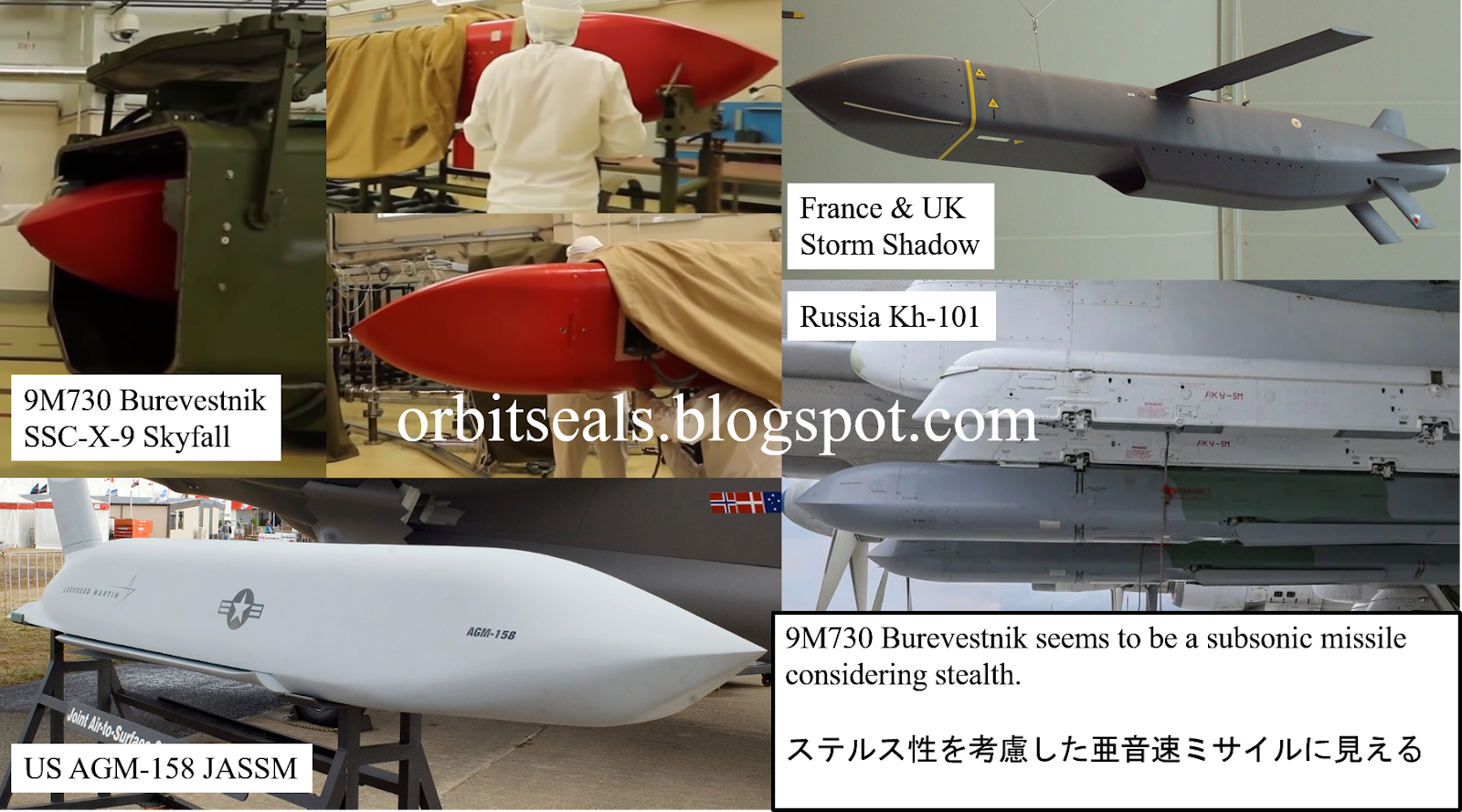
The air intake of the ramjet-powered aircraft, like the SLAM, is designed to fly at supersonic speeds, and the air intake of the fuselage and engine is often at a sharp angle to generate shock waves. However, the nose of the Brevestnik cruise missile is not shaped like that.
Comparison of Brevestnik cruise missiles and the tips of subsonic cruise missiles from different countries
It appears to be a subsonic missile designed to be stealthy.
Since the nose tip is not so sharp, this missile does not appear to be aimed at a high velocity range exceeding Mach 1. It looks like the nose tip shape of a subsonic cruise missile.
Missiles with a similar tip shape include the U.S. AGM-158 JASSM, Russia's Kh-101, and the French and British Storm Shadow. All of these missiles are designed for subsonic cruising and, in addition, are designed to be stealthy.
The nose of the Brevestnik cruise missile has a triangular cross-section, which prevents vertical reflection of radar waves coming from the side. The front shape of the nose section, like the other missiles mentioned above, appears to be designed to be stealthy. If these images are to be believed, the Brevestnik cruise missile may have been designed as a subsonic cruise missile with some degree of stealth consciousness.
From this, we can assume that the Breveznik cruise missile is powered by a nuclear propelled jet engine (i.e., a turbojet engine or turbofan engine type nuclear propulsion engine) rather than a nuclear propelled ramjet engine. Even if nuclear power provided infinite range, the speed is unlikely to be much faster than the speed of sound.
During the Soviet era, Russia has experience in research and development of large nuclear propulsion turbojet engines for manned aircraft, but unlike the United States, Russia has not developed small nuclear propulsion ramjet engines for missiles. (Not in the public domain.)
This is one of the reasons why the nuclear propulsion jet engine was selected as the method of choice, although the scale of the propulsion system is different.
4-2.Thoughts on the Brevestnik cruise missile launch scene
Brevestnik cruise missile during booster burn
He's got a big booster in the belly of the fuselage.
(The bottom two are missing white smoke due to image analysis.)
The video of the test launch shows that it is a simple solid-fuel rocket booster held in the belly to accelerate the rocket and then switch to a nuclear engine. In contrast to this type of body, the large rocket booster held in the belly is supposed to be detached after engine start-up.
Test image from the cockpit of a Chaser
The video shows footage of the rocket booster "only" in operation, and footage from a manned aircraft is shown as a test chaser, but it only shows a scene with the booster's white smoke continuing through the clouds. (That is, when the booster is burning.)
The missile footage shown at the same time is also only an enlarged view of the booster flame and white smoke continuing. In other words, it can be concluded that the footage released to the public only shows images of the nuclear jet engines "not working" throughout.
5.Technical Challenges for Brevestnik Cruise Missiles
5-1.U.S. and Soviet nuclear propulsion jet engines that once existed.
Both the U.S. and the Soviet Union developed nuclear propulsion jet engines (nuclear propulsion turbojet engines) in the 1950s and 1960s.
Example of a nuclear-powered jet engine developed by GE in the United States: XNJ-140E
It was a nuclear jet engine with a beryllium oxide reactor
Maximum output 121MW, maximum dry weight 27.5 tons (4.4kW/kg)
In the United States, direct-cycle gas-cooled reactors, which were being studied at Los Alamos National Laboratory, evolved into research and development of various types of nuclear propulsion engines. The development of direct-cycle reactors (1951-1961) involved the development of three main propulsion systems: the nuclear propulsion turbojet engine, the nuclear ramjet engine, and the nuclear propulsion rocket engine. (SLAM is the nuclear ramjet engine.)
Two forms of nuclear-powered jet engines considered in the Soviet Union in 1956
The turbomachinery and shaft are rocker (top) and coaxial (bottom) types outside the reactor
The Soviet Union had a nuclear-powered propulsion jet engine program in existence at the same time as the United States, although publicly available information about the Soviet Union is more limited than that of the United States. There is no information that the Soviet Union had research and development of nuclear propelled ramjets such as the SLAM, while research and development of manned aircraft with nuclear propelled turbojets was underway.
The Myasishchev Design Bureau was developing nuclear propulsion jet engine-powered aircraft, such as the M-30, M-52, M-56K, M-60, etc. There is information that these reactors used molten metal coolants such as lithium and sodium to transfer heat from the reactors to the engines. The engines, on the other hand, were apparently cleverly built and were dual-engineered to run on "normal aviation fuel". (If aviation fuel was used, it appears to have been used with the reactor shut down.)
Unlike the SLAM nuclear ramjet engines, these nuclear jet engines were not directly cooled by air (primary cooling), but used air as a secondary coolant in a heat exchanger after primary cooling with lithium and sodium. In other words, it does not spew radioactive material directly.
The Brevestnik cruise missile is believed to have a nuclear-powered jet engine, but it is unclear whether it is the type of missile that spews radioactivity, as SLAM does, or the type of missile that doesn't spew secondary cooling, as the manned nuclear-powered jet engines do.
5-2.Technical issues of nuclear propulsion jet engines for missiles
More than half a century has passed since the United States and the Soviet Union stopped research and development of nuclear propulsion jet engines. However, if they try to develop a nuclear propulsion jet engine again, the technical challenges will still be the same factors as they were then, as described below.
Research and development at the time was aimed by the Soviet Union at mounting it on a large manned bomber, but the Brevestnik was a cruise missile, and there was also the challenge of "miniaturization".
1.Thermal control and thermal management technology
Missiles are smaller than airplanes, and the jet engines they can carry are also smaller. As a result, the air flow for cooling the nuclear reactor is low, so the challenge is how to cool it efficiently. How to efficiently heat the air and expand it to provide propulsion.
2.Heat-resistant material technology The only way to deal with the parts that cannot be cooled is to deal with the heat resistance of the materials.
3.Small nuclear reactor technology Miniaturization of reactors that can be mounted on missile-sized aircraft. Miniaturization of various other auxiliary equipment.
⇒ Air is a propellant and a coolant for the reactor. (It is unclear whether Brevestnik spits out radioactivity by direct cooling (primary cooling) like SLAM, or whether it is suppressed by secondary cooling), but there is a possibility that the cruising altitude may be limited due to the incoming air flow rate and air density.
6.What was the cause of the Brevestnik cruise missile accident? (Reasoning)
Please note that all of the following is an estimate and speculation.
On August 8, 2019, an explosion occurred at the navy's maritime test site near Nyonoksa in the northern Russian province of Arkhangelsk on August 8, 2019, killing five employees of the Russian nuclear company Rosatom, who were working on the experiment.
The incident was initially reported as "an explosion during a jet engine test" or "an explosion during a liquid fuel jet engine test". Later on, the details of the announcement, such as "isotope power source (battery)," were mixed, with experts and others suggesting that it was an attempt to hide the nuclear propulsion engine accident.
A few days later, the possibility that this was an accident during the development of the Brevestnik cruise missile has become stronger, but the details are confidential and have not been made public.
Some have suggested that the initial announcement may have been a lie, but due to a matter of wording, they may not have been lying about some of it. The reasons are as follows.
The Brevestnik cruise missile is believed to be equipped with a nuclear propulsion jet engine (turbojet engine or turbofan engine). A jet engine is defined as a propulsion engine that draws in air from the outside to generate a jet stream, so the Russians can claim that the reports of a jet engine explosion during testing are not false.
There is information that the Soviet Union had previously developed a nuclear-powered propulsion jet engine for a large bomber, which was a dual system that provided nuclear propulsion but also ran on "conventional aviation fuel". If the engines on the Brevestnik were dual type, then they could run on liquid fuel, so it would not be a lie for the Russians to claim that the "liquid fuel jet engine exploded".
Also, if "liquid fuel" was used for the starter to start the engine, the Russians can claim that it is not a lie, because if you cut out part of the start-up, it could be called a "liquid fuel jet engine".
The cause of the accident has been announced in two or three different ways, and the truth is unknown, but I think a reasonable line is around "failure of the nuclear propulsion jet engine during ground operation".
In the third above, I mentioned the starter, but it is believed that the jet engine was launched from the rotating part of the jet engine and the reactor not yet started, using a solid fuel rocket booster. We assume that the nuclear propulsion jet engine would be started in the air. This supposition is based on the following reasons.
Rather than exposing a nuclear reactor to the rapid acceleration of a rocket booster, it makes more sense to start the reactor after the acceleration has decreased.
If the reactor is started on the ground and there is an accident inside or around the launcher, it will self-destruct, spreading radioactivity and preventing it from getting close to the launcher. For this reason, it is highly likely that the engines will be started after the launcher has been fired and at a distance. (Though in this case it did self-destruct...)
The nuclear propulsion jet engines that the Soviets used to mount on manned aircraft required heavy metal shields to protect the crew from radiation generated during operation, and they were loaded with them. Would the shields, which became heavier and heavier as they were loaded, be placed inside a missile fuselage with no room to spare, and then shielded so that radiation would not be emitted from all sides of the reactor? Would we give that much thought to a disposable missile launched against an enemy? If the shielding is inadequate to save weight, then the act of starting the reactor without adequate ground conditions would be an act of exposure.
If shielding is inadequate to save weight, the rocket booster would not only be an accelerator to get the jet engine to a predetermined speed at which it could be started, but it would also be a safety device necessary to start the reactor inside the engine in a safe zone far enough away from the Russian side.
(As an aside, given a missile approaching to intercept against Brevezstoke, could the radiation cause the electronics to malfunction if it approaches from a poorly shielded direction?)
And the sequence of nuclear propulsion jet engine start-up is considered to be as follows.
The solid rocket booster accelerates the engine to a predetermined speed at which it can be started.
A liquid fuel or other chemical agent starter starts the jet engine, and air is taken in to increase the speed to steady state.
Start up the reactor, start air cooling and switch propulsion sources.
Start of steady-state engine operation.
With regard to the above, if we cut out some of the start-up time, it could be said to be "testing a liquid fuel jet engine".
However, if the development of the Brevestnik cruise missile goes ahead, no matter what warhead this type of weapon carries, whether it hits the target or fails to fly, the small reactor called a "nuclear propulsion jet engine" will be slammed into the ground or sea surface. The result would be radioactive contamination, as was the case in this accident. Even without a warhead, this kind of missile would be a tricky weapon, a default dirty bomb.
7.Postscript: Small Reactor Structure and Liquid Fuel Starter Speculation
This article introduces the mechanism of the nuclear propulsion jet engine from the report of the US manned nuclear propulsion jet engine: XNJ140E, and explains the presumed reason why the liquid fuel was necessary.
XNJ140E used highly enriched uranium to achieve a small size high power reactor, which was not low in concentration like the large steam type reactors on the ground.
The fuel for the small reactor on XNJ140E consisted of beryllium oxide containing enriched uranium dioxide (~93% U235). The uranium dioxide was stabilized by yttrium oxide, a specification that limited the conversion of the uranium dioxide to higher oxidation states. The fuel surface was also coated with zirconium oxide. This coating prevented steam corrosion of the beryllium oxide. The maximum operating temperature of XNJ140E is 1388°C.
Because of its high cooling capacity (= high boiling point and specific heat capacity), lithium hydride, a liquid metal, was used as the coolant. Because of its high cooling capacity as a substance, it can remove heat from the reactor without excessively high refrigerant pressure and in a lightweight structure.
Russia's nuclear propulsion engines in the past also used lithium and sodium for primary cooling, as explained earlier, and for the reason that they had to have small, high-powered reactors of different sizes, I think it is highly likely that the configuration of enriched nuclear fuel plus liquid metal coolant was used in the engines of the Brevestnik cruise missiles as well.
And when starting up such a reactor, the coolant must be pre-heated (preheated) to above its melting point before starting up the engine, since the coolant is solid at room temperature. This means that a chemical agent is needed as a starter at start-up, and I wonder if it is possible that it was liquid fuel.
Of course, an air stream has to be pumped into the jet engine mechanism as a rotating machine as well as the small reactors. At start-up, a chemical agent as a starter for the gas generation is needed to generate the starting gas to increase the speed of the blades.
Thus, we believe that a starter is needed to start the entire nuclear propulsion jet engine system and that a liquid fuel may have been installed for this purpose.
8.Postscript: Cause of accident (Update:2020.09)
Alexei Likhachev, president of the state-run nuclear company Rosatom, said the five researchers who died were developing "new weapons" over an explosion at a missile test site in Russia's far northern Arkhangelsk province. He admitted that he would continue to conduct the tests after the explosion.
The accident took place on August 8 at a military facility in the Arctic Circle off the coast of the White Sea, but it was not until August 10, 2019, that authorities acknowledged it was a nuclear-related incident. They said the explosion caused a sharp increase in radiation levels.
Rosatom explained that officials were providing engineering and technical support for the missile's "radioisotope source". The explosion occurred when the fuel ignited while conducting missile tests at an offshore facility, and the blast blew several personnel out to sea, he said. These were not nuclear explosions, but rather explosions that occurred during missile engine testing, and the radioactive material used in the fuel was scattered around the area, Russian military officials explained to local residents.
There were two schools of thought among experts over the accident, one speculating that a small reactor in the engine of a nuclear-propelled cruise missile under development exploded, and the other that it was an accident of a "liquid-fueled propulsion system using radioactive isotopes," but, at least from the announcement, "the chemical liquid fuel caused the explosion and the nuclear part of the It was damaged by collateral damage. It fits the consistency of the idea.